Pages

Reporter on the Street - Joan in Madrid

Sunday, April 18, 2010

Museo del Prado, Madrid Vision, Luis De La Candelas

We started the day at the Prado. Wonderful sunshine streamed down on us as we made our way from Plaza Espana to the Prado.

The Museo del Prado is a museum and art gallery located in Madrid, the capital of Spain. It features one of the world's finest collections of European art, from the 12th century to the early 19th century, based on the former Spanish Royal Collection. Founded as a museum of paintings and sculpture, it also contains important collections of more than 5,000 drawings, 2,000 prints, 1,000 coins and medals, and almost 2,000 decorative objects and works of art. Sculpture is represented by more than 700 works and by a smaller number of sculptural fragments. The painting collection comprises about 7,800 paintings, of which only about 1,300 are at public display, mainly because of the museum's lack of space. A new, recently opened wing enlarged the display area by about 400 paintings, and it is currently used mainly for temporary expositions. El Prado is one of the most visited sites in Madrid, and it is considered to be among the greatest museums of art in the world

We saw many masterpieces from El Greco, Goya, Velasquez, Ruebens and many others. When we finished our “Tomba Tour” – with our English headset, we headed outdoors to take a bus tour on Madrid Vision. Madrid Vision is a double decker – open top bus that winds its way through the city streets of Madrid allowing everyone to “see the sights” and listen to commentary about the sites. No better way to get a sense and feel of the city and to get in touch with the “gonnas” of the people. The first leg of the tour was “Old Madrid”. It was wonderful to “see” Madrid from this vantage.

After 2 hours, we decided to get a quick bite at the Prado Restaurant (across the square from the Prado) – and to our delight – we again had a wonderful Andalusian meal of Iberian meats and a Veal steak that was out of this world.

Back on the afternoon bus for a tour of Modern Madrid. The Modern Madrid was constructed mostly in the 20th century and featured modern high rises, with less character and style than the baroque buildings in Old Madrid. While interesting to see the contrast, the new “heights” did not appeal to us.

For dinner, we supped on Roast Lamb and other spanish fare at the famous “Cuevas De la Luis Candelas. The restaurant is named after Luis Candelas Cajigal ( Madrid , " February 9 1804 - Madrid, November 6 of 1837 ) who was a bandit Spanish born in the Madrid neighborhood of Lavapies. He was executed on November 6 of 1837 in Plaza Mayor, adjacent to the restaurant. And a chocolate cone to top off the night!

Tomorrow, we pick up our touring car and head to Toledo and Cordoba!

Friday, April 16, 2010

Enrique - Bailey's distant "Spainish" cousin

As we were walking by the Palacio Real (Royal Palace), we saw a Yorkie and noticed a uncanny resemblance to you know who -- Bailey. Well, we met Enrique and found out that he was related to Bailey through a long line of royal "Yorkies" -- except Enrique has a "taste" for "caballeros" not "senoritas" -- he was actively trying to "hook-up" with another caballeros -- so we moved on....

Casa Botin - Oldest Restaurant in the World

The first time I visited Casa Botin was in April 1979, when my mom introduced me to world traveling. My younger brother David was studying at the University of Madrid and my mom thought it would be a good idea to visit him and spend some time seeing Southern Europe. She was visionary. We visited Spain, Italy and Greece and had a spectacular time. We spent 6 weeks in Europe. I was hooked.

Casa Botín restaurant dates from 1725, when the ground floor of what was previously a small inn (since the late 16th century) was reformed and around the same time a log-fired, cast-iron oven installed. This type of oven is typical of Castillian restaurants, where roasts of all types (meats, fowl) are the mainstay of Castillian cuisine. The restaurant has 4 floors and is located in Cuchilleros street, a short walk from Plaza Mayor.

Joan and I re-visited Casa Botin for a late lunch. There is obviously a good reason this restaurant has been around since 1725 (the oldest restaurant in the world according to the Guinness Book of World Records). We entered on the ground floor went downstairs to the the "bodega" or old wine cellars. Main courses in Spanish restaurants can be very spartan where vegetables are concerned and Botín is no exception. This is just the way it goes- the Spanish tend to separate their vegetables and serve them up as starters.

We had a sampling of their famous fare -- Dried Iberian Pork Loin, White Asparagus with Mayonnaise, Calamari, and the house specialty -- Roast Suckling Pig. We accompanied it with a Marques De Riscal Tempranillo 2005. The suckling pig was fantastic - the meat was very tender and covered with "crackling" - the crisp, roasted skin which cracks when cut and tastes simply delicious. Incredible!!


Thursday, April 15, 2010

The Mesonas - Tapas Bars in Plaza Mayor

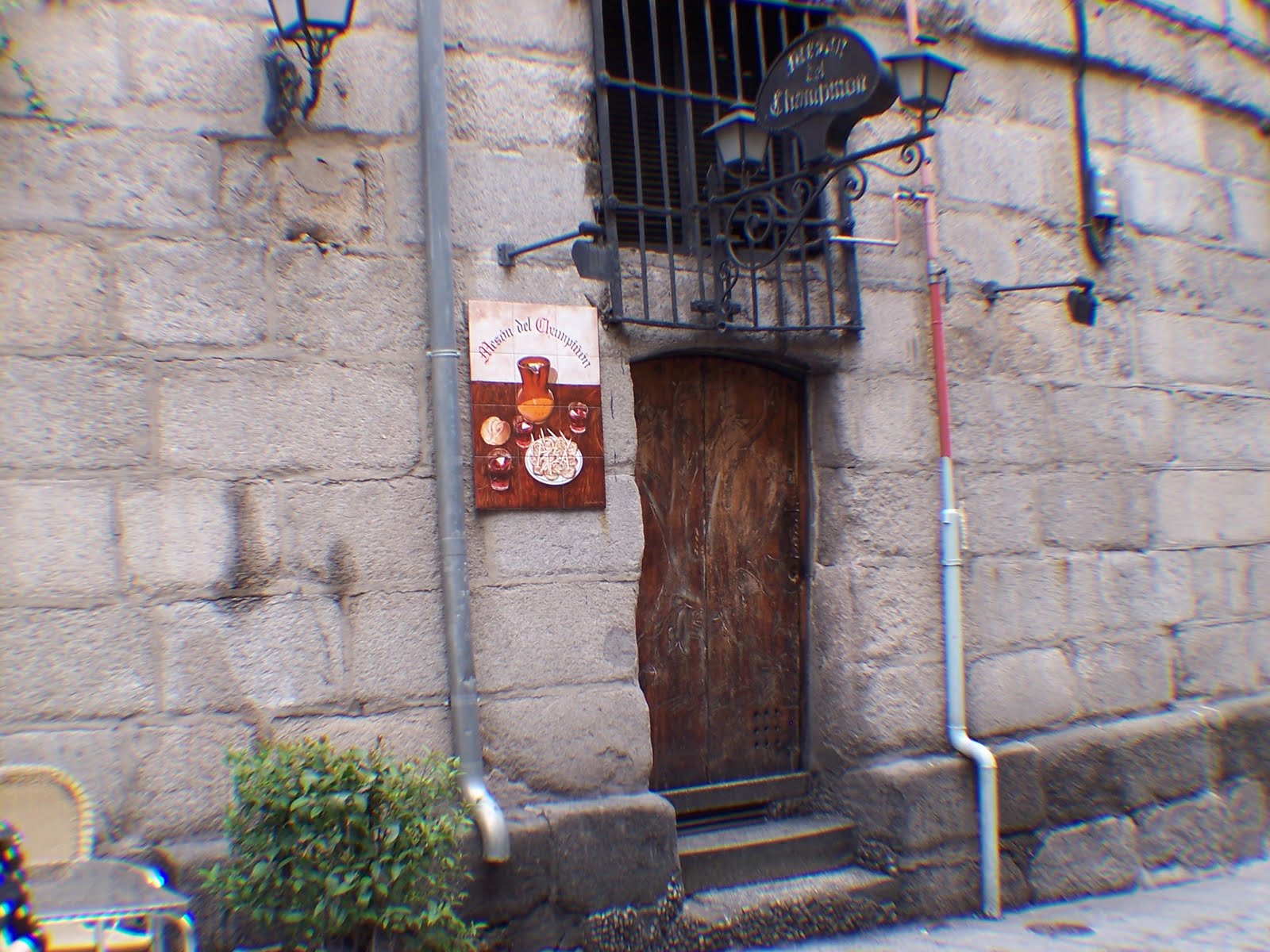
Here are selected photos of the various "Mesonas" that line Cava De San Miguel.


Plaza Mayor, Casa Botin's and a walk through "old Madrid"

After a delightful catch-up nap, we ventured out to walk through "Old Madrid". So we took a cab to Plaza Mayor, where we started our tour.

The Plaza Mayor was built during the Hapsburg period and is a central plaza in the city of Madrid, Spain. It is located only a few blocks away from another famous plaza, the Puerta del Sol. The Plaza Mayor is rectangular in shape, measuring 129 by 94 meters, and is surrounded by three-story residential buildings having 237 balconies facing the Plaza. It has a total of nine entrance ways. The Casa de la Panadería, serving municipal and cultural functions, dominates the Plaza Mayor.

The origins of the Plaza go back to 1589 when Philip II of Spain asked Juan de Herrera, a renowned Renaissance architect, to discuss a plan to remodel the busy and chaotic area of the old Plaza del Arrabal. Juan de Herrera was the architect who designed the first project in 1581 to remodel the old Plaza del Arrabal but construction didn't start until 1617, during Philip III's reign. The king asked Juan Gomez de Mora to continue with the project, and he finished the porticoes in 1619. Nevertheless, the Plaza Mayor as we know it today is the work of the architect Juan de Villanueva who was entrusted with its reconstruction in 1790 after a spate of big fires. Giambologna's equestrian statue of Philip III dates to 1616, but it was not placed in the center of the square until 1848. If you look around today you can still see the blood on the walls from some of the bull fights held in earlier years.

After a walk through the "Plaza", we headed down Cava de San Miguel -- the road that runs by the "caves" below the Plaza. These were the catacombs that were used after hangings had taken place in the Plaza over 400 years ago -- the "Caves" have since been turned into quaint "bars" and "mesonas" -- tapas restaurants -- with a variety of themes - Mesonas de la Guitar, Mesonas de Champignon (The Mushroom); Mesonas Jamon (The Ham). These colorful tapas bars dot both sides of the street as it winds it way downward to our lunch destination -- Casa Botin.

The Volcano Erupts!

As we left the surreal bonds of the US airspace, bound for Madrid, Spain, on our Aer Lingus flight, little did we know that a volcano in Iceland had decided to start erupting. Fortunately for us, there was no impact on our flight as the jet stream had kept the ash plume in the Northern Europe/Scandinavia air space.

Britain Closes Airspace as Volcanic Ash Spreads

New York Times - Alan Cowell, Nicola Clark - ‎1 hour ago‎
PARIS - British civil aviation authorities said on Thursday they would close the country's airspace at noon to shield aircraft from a high altitude cloud of ash drifting south from an erupting volcano in Iceland.

Our flight was flawless and we sleep like babies -- twisting and turning and not getting a wink. When we arrived on the ground, there was a light rain and overcast skies. Everything went on schedule. Bags on time. AMEX Foreign Exchange was open. Our taxi driver - Joseph - was delightful. He gave us a great verbal tour in Castilian Spanish and English about Madrid, Queen Isabella and King Ferdinand and the Grand Inquisition.

We checked into the Melia Madrid Princess hotel and our room was ready -- and quite nice -- they really do know how to pamper guests and the room was attractively decorated in a modern "art deco" decor.

Off to sleep to make up for last night, then onward to Casa Botin's for lunch!

Friday, April 9, 2010

The "Tomba" Tour Schedule

On the road to Spain
Apr 14 - Apr 24, 2010 - Madrid, Spain

Cordoba, Spain; Marbella, Spain; Toledo, Spain; Washington, DC

April 14 - Depart Washington, DC.

April 15 - Arrive Madrid, Spain.

April 15 - 17 - Tour Madrid, see the Prado, Old Town Madrid, Royal Palace, dinner at Casa Botin's and Cuevas Luis de la Candelas, Plaza Mayor, Tapas at the Mesonas.

April 17 - Day trip to Toledo for lunch and onward to Cordoba to see the Mosque and stay in a the Cordoba Paradore.

April 18 - Drive through Andulusia to Marbella; staying with The Munoz at Marriott's Marbella Resort.

April 19 - Tour Marbella, Torremelinos.

April 20 - Day trip to Ronda.

April 21 - Lounging in Marbella; tennis, golf & whatever

April 22 - Day trip to Seville.

April 23 - Head back to Madrid via Malaga

April 24 - Flight back to Washington, DC.